Woolston Eyes 2nd May 2023
The birding group were due to go to Macclesfield Forest on 2nd May but I chose not to go there because of the hilly nature of that particular walk. Instead, we decided to go to Woolston Eyes nature reserve and we had a very pleasant morning with a good number of species including the year-tick Black-necked Grebes that it is so famous for.
There has obviously been a fair bit of work done on the reserve and the first sign of that was a new footpath on the bridge and the portaloo placed just on the reserve side of it. At the first platform there was a surprisingly good variety of ducks with lots of Pochards and gadwalls but also Tufted Duck and Shelduck. A single Great- Crested Grebe could be seen there but we had to move on to find the Black-necked Grebes which we did at both the next platform and the main hide.
At the main hide, it took a little while for the Black-necked Grebes to appear but slowly they drifted into view, often at the very back of the water. There were large numbers of Black-headed Gulls and several Greylag Geese and Canada Geese. As we sat at the Morgan hide, a Great Black-backed Gull swooped down and took one of the Greylag goslings and it flew straight past the hide with the unfortunate chick in its mouth.
In the reeds in front of the hide we heard both Sedge and Reed Warblers and got views of a Cetti’s Warbler singing from a willow sapling at the edge of the reeds. The Reed and Sedge Warblers were both year ticks. On the feeders we got Bullfinch, Greenfinch, Coal Tit and Greater Spotted Woodpecker. A Marsh Harrier did a fly-by, raising all the gulls in a frenzy but it just flew over briefly. A single Lapwing was flying around a couple of Swallows hawked over the water.
There were birds singing all over the site and we heard a range of Robin, Blackbird, Wren and Blackcap song as we walked around the site. It gave me an opportunity to check out the new AI enhanced “ID by Sound” feature of the Cornell Lab’s Merlin App which seemed remarkably accurate despite sometimes very low volume of the source bird songs. It even seemed to accurately identify several species all singing at the same time and the response was surprisingly quick – in some cases instant. I can’t wait to try it out on something that I genuinely can’t identify myself.
Altogether we got 36 species of birds including three good year ticks.
Bird Sightings : Woolston Eyes Reserve 2nd May 2023
| Species | No |
|---|---|
| Black-headed Gull | 60 |
| Black-necked Grebe | 4 |
| Blackbird | 2 |
| Blackcap | 2 |
| Blue Tit | 1 |
| Bullfinch | 3 |
| Buzzard | 1 |
| Canada Goose | 20 |
| Carrion Crow | 8 |
| Cetti's Warbler | 1 |
| Chaffinch | 1 |
| Chiffchaff | 4 |
| Coal Tit | 1 |
| Coot | 8 |
| Gadwall | 20 |
| Great Black-backed Gull | 2 |
| Great Crested Grebe | 2 |
| Great Spotted Woodpecker | 1 |
| Greenfinch | 1 |
| Greylag Goose | 12 |
| Lapwing | 1 |
| Mallard | 4 |
| Marsh Harrier | 1 |
| Moorhen | 1 |
| Mute Swan | 4 |
| Pheasant | 1 |
| Pochard | 20 |
| Reed Warbler | 1 |
| Robin | 2 |
| Sedge Warbler | 1 |
| Shelduck | 6 |
| Swallow | 2 |
| Tufted Duck | 8 |
| Whitethroat | 1 |
| Woodpigeon | 3 |
| Wren | 3 |
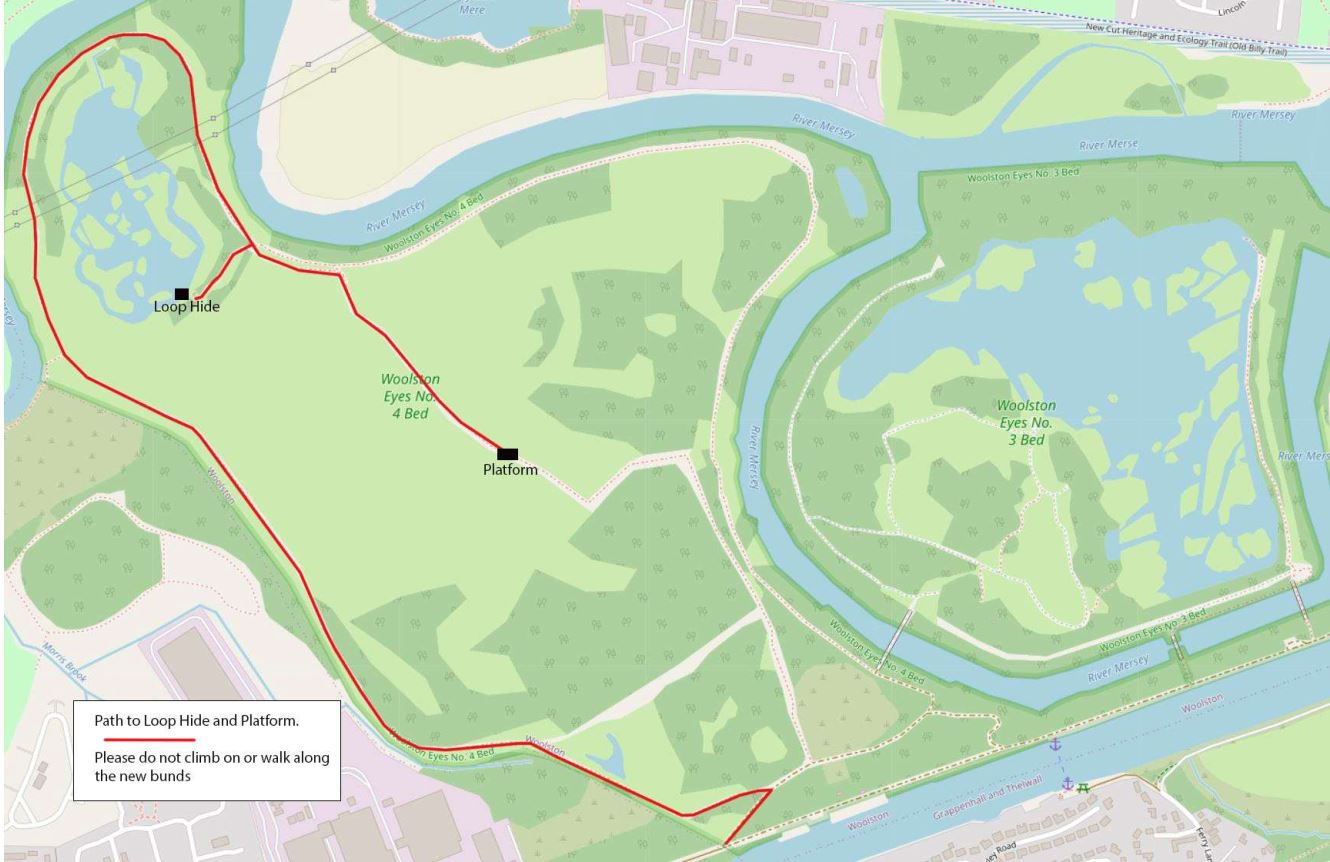
Woolston Eyes Number Four Bed “Loop”
While we were sitting in the main hide, we got into conversation with a chap and he told us that he effectively ran the site (I can’t believe we didn’t ask him his name!) and he told us about the whole new development of Number Four Bed (“The Loop” which is described here. It apparently takes forty-five minutes each way so we didn’t have enough time to do the walk but we had a quick recce of the first part of the path – incidentally ticking our first Whitethroat of the year. We intend returning to it later in the week and dedicating ourselved to just that part of the site.