
Birding in The Brecks Day 1 : 23rd March 2013
Birding in The Brecks Day 1 : 23rd March 2013
While we were getting work done on our house we thought that it would be a good idea to get away for a week when all that was left to do was the painting work which we felt could not really go wrong. As it happened the work finished before we expected and we found ourselves going on holiday on the last day of the painting work.
We had planned to mix visiting friends with a bit of birding so, after a bit of research we thought that a visit to the Brecklands would be a good idea – perhaps we could see Goshawks, Firecrests and Hawfinches ? What we had not built into the plan when we arranged all this was the weather as blizzards closed down large parts of the country and led to week-long power cuts in Ireland and the coldest March for fifty years. However, our plans were made and we had no intention of calling off a much needed break from a house turned upside down by plasterers, carpenters and painters and, with carpets lifted, radiators removed and windows open to let paint fumes out, freezing cold. How much colder could it be anyway ? We were about to find out !
We had been to the Brecks last year and were quite taken with the interesting habitat of open woods and lowland heath and although it was probably too early for Stone Curlews we still thought it might be good for Goshawks and some other species. A bit of research on the internet and we found a birding guide , Stuart White, who did two-day birding tours of the Brecks. Helpfully he had an arrangement with the Crown Hotel in Mundford – just at the top of Thetford Forest – than gave birders booking on his birding tours a £10 per day per room discount. when staying at the Crown for that purpose. When his Brecks tours are on he picks birders up from this location every morning and drops them off again at the end of the day. It couldn’t have been easier and, after a little teething trouble with the room temperature and a slightly longer problem with the amount of hot water available, we settled in well with a pleasant room in one of the annex buildings next door. In fact they seem to own many buildings throughout the village that they let out. Anyway the food in the pub was very good and very reasonably priced, the had acceptable beer and log fires so we were well set up.
The following morning started off not quite as expected. We had managed to come down from Manchester avoiding much of the snow and bad weather that the country at large was suffering from and we thought we had got away with it but we arose on the Saturday morning to a blizzard of snow that started and did not stop all day long. We met our guise, Stuart, who was obviously not over happy birding in the snow but presumably he did not want to lose a days money from seven birders at £45 each and we were game for it anyway since we had travelled all the way there for the purpose of birding in the Brecks. We all hoped that the weather would improve but it did not.
Stuart turned out to be a rather odd chap who was not very communicative and the experience was more like following someone as they were birding than being guided. He rarely told us where we were driving to or where we were when we got there and when we enquired of him where were at at one point he replied that it didn’t have a name ! He didn’t tell us anything about the birds or their habitat either so really we were going to have to judge him by what birds he could actually find for us which was a problem since the snow started falling quite heavily as we walked along a bank of the Little Ouse near Santon Downham for about a half a mile. As we went we saw Siskins and a few Bramblings but we could not see the Lesser Spotted Woodpecker that he was hoping to show us. So back we went and as we walked back along the river we did see Treecreeper, Nuthatch and Wren but we could have seen these anywhere so we were not that impressed as yet. On the plus side we saw a flock of around 200 Redwing who were actually singing – an unusual thing to hear in Britain and even more unusual in that they would suddenly all stop together and restart together.
Later on we went to part of the Forest that according to Stuart “did not have a name” but the road signs indicated that Grimes Graves was somewhere nearby. Here we got sudden and very brief views of a pair of Woodlark and quite a few Meadow Pipits.
Our next stopping point was Lynford Arboretum which was quite close to Mundford and where we hoped to get views of Hawfinches. As it happens we didn’t see any but there were good views of various Tits and other common birds on the feeders.
A lot of the day we seemed to be going up and down sections of the Little Ouse and we eventually parked in the centre of Thetford where both the Little Ouse River and the River Thet pass through. On the River Thet we came across a horde of photographers who were taking pictures of Otters that were showing very well indeed and even coming on to the banks a few feet from the photographers that, never satisfied, kept getting closer and closer to the animals to the extent that the Otters had to take their catch and try to eat it in peace elsewhere. Apparently the problem with photographers had become that bad that some had actually been banned by the courts for bothering the Otters.
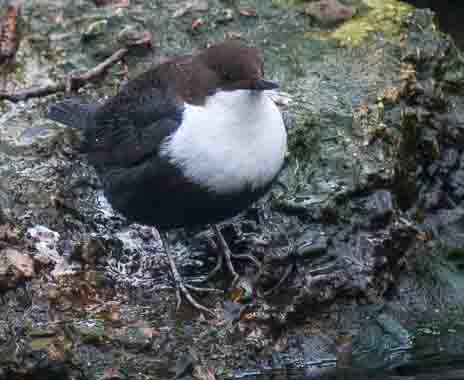
Anyway the odd photographer and a few other birders were less concerned with the Otters than they were with finding an even rarer animal that had been seen recently on the river and that was the Black-bellied Dipper. We found the bird near the Three Nuns Bridge on the River Thet in Thetford. Dippers are always a joy to watch and this one was quite happy to be photographed – I even managed to get some digiscoped images using my new Swarovski ATX scope and adaptor – but this one was a very different bird to those you usually see. (Although there has been some speculation as to whether this bird was truly a rare – in Britain – Dipper of the race, cinclus as opposed to the usual British races, for instance see this thread on the Birdforum.net website although personally I am more convinced by the the BTO’s acceptance of this bird as a true cinclus) According to “Birdwatching” “magazine :
The Cinclus is just one of about 13 subspecies of Dipper, extending across the Palearctic from Morocco in the south to Norway in the north and eastwards as far as the Himalayas. The Black-Bellied Dipper occurs in Britain as a scarce visitor. It is one of the continental races that breeds in the north of Scandinavia and migrates south to escape the clutches of winter. Birds breeding in the mountains of Norway and Sweden leave for lower ground and warmer weather in Finland, southern Sweden and western Germany. They arrive in their winter homes in October and leave again in March. Individuals of this race are usually easy to distinguish from the British races, which have chestnut bellies. These occasional visitors provide the opportunity to see Dippers where you wouldn’t expect them, especially in southern and eastern England, and most occur from October onwards, often staying until March. Ringed black-bellied birds – a Swedish bird in Fife and a Norwegian bird on Shetland – confirm their northern origin.
Black-Bellied Dipper, River Thet, Tetford 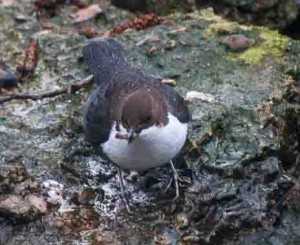
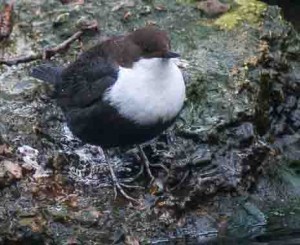
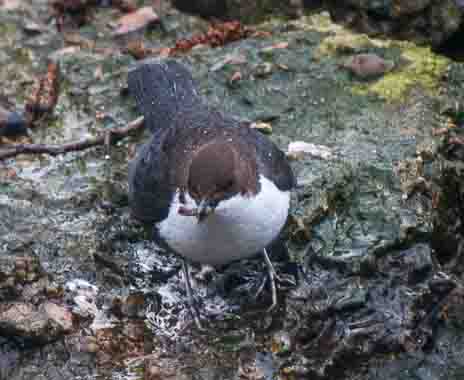
A lot of excitement caused by a little bird then but a great pleasure to see ! We also saw an Egyptian Goose on a lawn by the banks of the river and at another location in Thetford Forest we also managed to see Goldcrest, Marsh Tit, Kestrel and some other, more usual, birds. All day the snow kept falling however and, apart from a brief stop for a cup of tea in a distinctly odd Portuguese cafe, we were all tiring a bit from the incessant cold. Constantly cleaning snow from our bins wasn’t helping either. Still, all in all we had had a pretty good day under the circumstances and we could add Woodlark and Marsh Tit to our year list as well as getting great views of Otters and Black-Bellied Dipper !
Stuart’s Blog for that day can he found here
Bird Sightings : Thetford Forest
| Species | Count |
|---|---|
| Mute Swan | 2 |
| Greylag Goose | 6 |
| Canada Goose | 8 |
| Egyptian Goose | 1 |
| Mallard | 8 |
| Pheasant | 1 |
| Little Grebe | 1 |
| Kestrel | 1 |
| Moorhen | 1 |
| Black-headed Gull | 8 |
| Woodpigeon | 4 |
| Great Spotted Woodpecker | 1 |
| Jay | 1 |
| Jackdaw | 10 |
| Rook | 20 |
| Goldcrest | 2 |
| Blue Tit | 4 |
| Great Tit | 4 |
| Coal Tit | 1 |
| Marsh Tit | 1 |
| Woodlark | 2 |
| Long-tailed Tit | 6 |
| Nuthatch | 1 |
| Treecreeper | 1 |
| Wren | 1 |
| Dipper (Black-bellied) | 1 |
| Blackbird | 4 |
| Redwing | 200 |
| Robin | 4 |
| Dunnock | 2 |
| Meadow Pipit | 8 |
| Chaffinch | 10 |
| Brambling | 2 |
| Goldfinch | 6 |
| Siskin | 2 |