Open Day at Rostherne Mere 15 September 2012
Open Day at Rostherne Mere 15 September 2012
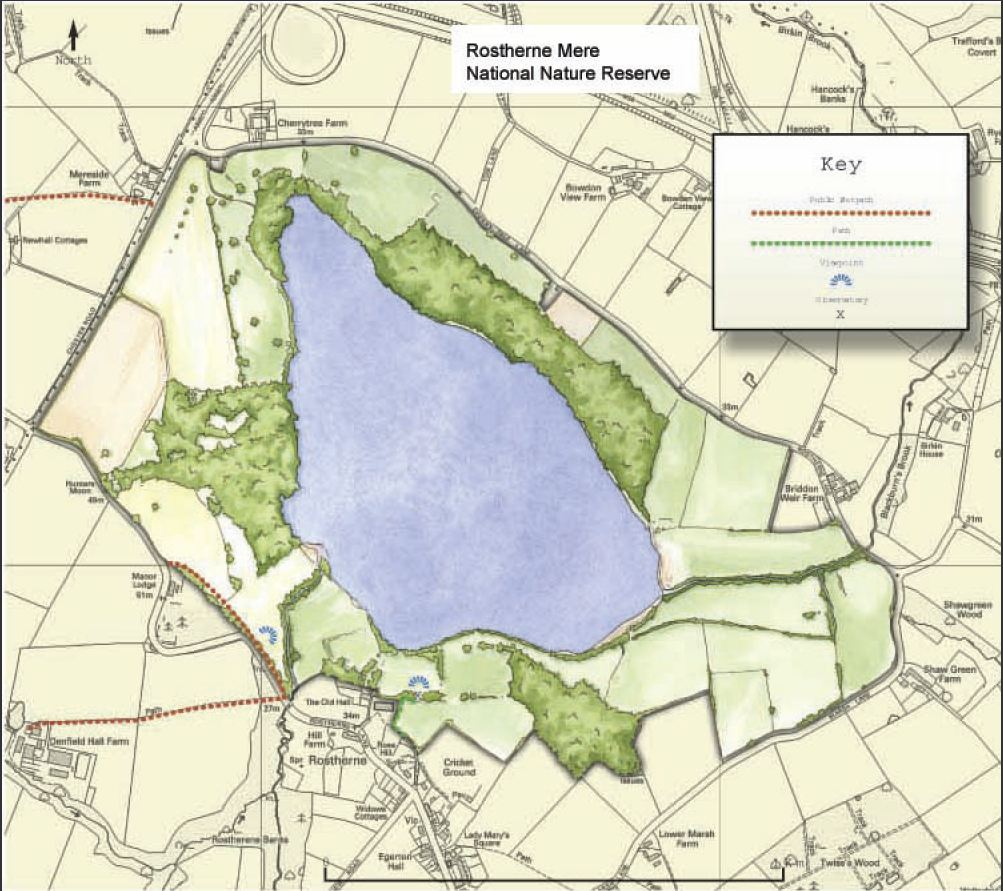
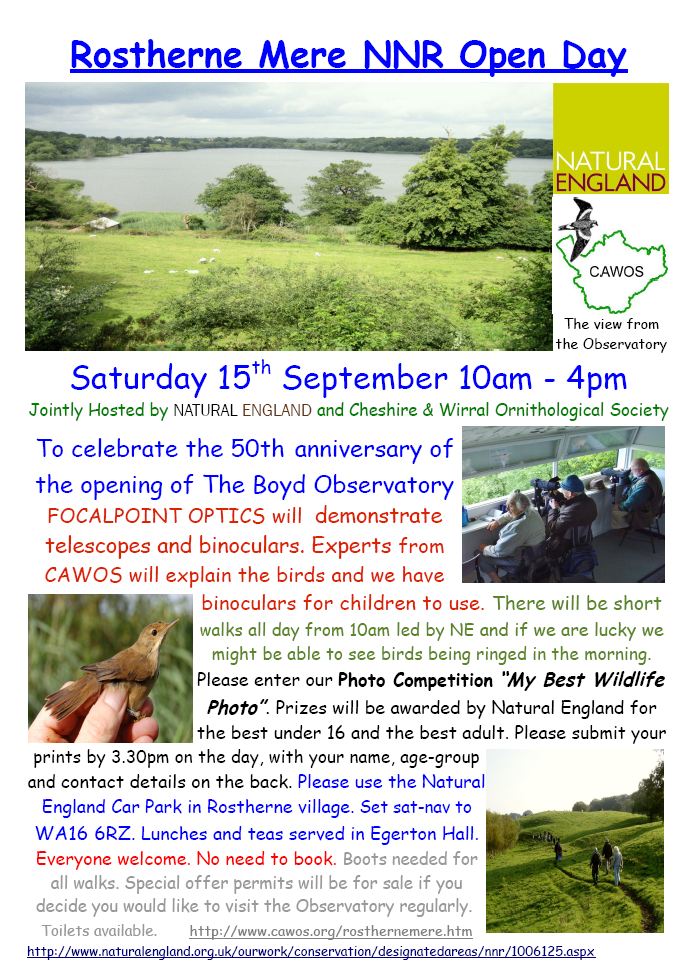
We attended an open day at Rostherne Mere nature reserve organised by Natural England. and CAWOS (The Cheshire and Wirral Ornithological Society). This was to celebrate the 50th anniversary of the opening of the Boyd Observatory. We had been to Rostherne Mere before but the hide is reserved for members of CAWOS who operate it. We had the opportunity to go inside the hide which had tea making facilities and a toilet and enough room for about 13 to 14 people viewing. The hide is in an elevated position and it looks over the Mere which, at 30 metres, is the deepest of the Cheshire meres and does not freeze over due to this great depth and its general surface area which is considerable. Whilst we were in the hide we saw a Buzzard perched on a branch overhanging the water and a Kestrel also perched on a branch but spent most of the time we were watching preening.
On the water there were large numbers of Mute Swans, Canada Geese and Black-headed and Lesser Black-backed Gulls. There were around a dozen Great-crested Grebes as well as lots of Mallards. In the trees there was a significant Cormorant roost amounting to some thirty or so birds. There were also three Grey Herons and, as ever, Coots. There were also still a few Swallows flying over the water even at this late stage of the season. On the feeding platform outside the hide window we saw several Nuthatches come and go as well as Great , Coal and Blue Tits.
We had the opportunity to go on a short walk down the concessionary path that starts just after the observatory (but which can also be reached by parking at the NNR car park which in the village opposite Egerton Hall and walking around the edge of a field. This path gives one particularly good view of the Mere as a whole and descends through the woodlands that end at the reedbeds where Reed Warblers nest annually and where there is apparently a substantial winter Starling roost. We were led by a Natural England employee who described the reserve as we walked and then passed us over to a couple of volunteers who were involved in bird ringing. They had mist nets erected and were playing a Willow Warbler song recording as a lure. We then had a very interesting talk about the Reed Warblers and their life on this site.
We walked back up to the observatory for another look before heading off to Egerton Hall in the village where there was tea and cake laid on. Whilst we were there we spoke to the membership secretary for CAWOS and she described some of the work the society does and some of the benefits of membership. Although we really were mainly interested in obtaining entry to the Boyd Observatory (£5 per annum for a pensioner !) we also joined CAWOS as it seemed like it was a very worthy society and we thought that we could try it for a year and see whether it was useful to us.
It has to be said that the Mere generally is better in the winter months when large numbers of birds roost on the water – especially when other bodies of water freeze over.
CAWOS membership or annual entry to the observatory can be arranged by emailing memsec@cawos.org. Day permits for the hide are also available for £1. CAWOS has also published an absolutely fantastic bird atlas of its area and whilst this is quite expensive, the full contents of it can be seen online here